WITNESS

World environmental ImpacT aNd Economics ScenarioS

  • Explore potential energy transition paths through simulation, 
    identify the most influential transition drivers
  • Jointly agree on a trajectory envelope, 
    engage a critical mass of actors to make it happen (self-fulfilling prophecy)
  • Estimate risk by measuring the difference between planned trajectory and worse ones


WITNESS is a framework to structure the problem following a system of systems approach, allowing to leverage numerical simulation methods and tools to build a complete world transition model.Such a framework makes it possible to plug-in and connect best-in-class models from various origins, in order to assess various strategies in the context of possible energy, resources, climate or economy evolutions, collaboratively securing and combining various experts’ advices on strategies strengths or weaknesses, coverage or gaps of the various strategies.


  • 2411067 – IAMC 2024
    Tipping points impact [slides]
    Complex system of systems simulation approach [poster]
  • 240417 – Linux Foundation OSS summit North America 2024
    Slide from Transition risk presentation [video] [slides]
  • 240207 – CAFÉ Climate and Health Conference 2024
    Slide from Transition risk presentation [slides]
  • 23/12/05 – COP28 presentation
    COP28 presentation on Linux Foundation stand [video]
  • 221123 – WITNESS@NAFEMS NRC_22 keynote
    “Complex system of systems simulation for energy transition” [slides]
  • 211216 – CESAMES Architecture Days ’21
  • System of systems approach for exploring energy transition risks [slides
  • 211107 – WITNESS@COP26
    COP26 introduction to WITNESS [10mn video]


WITNESS Overview

WITNESS stands for World environmental ImpacT aNd Economics ScenarioS. WITNESS is an Integrated Assessment Model framework developed using the SoStrades simulation platform. This framework has been designed to facilitate a comprehensive understanding and engagement with transition dynamics.
The primary goal is to collaboratively explore potential transition paths through simulation, pinpointing the key drivers that could steer these changes. The joint exploration aims to foster consensus on target trajectory envelopes, which is crucial for rallying a critical mass of stakeholders. Such collective agreement and engagement are seen as instrumental in successfully transitioning complete ecosystems.
Additionally, there’s an emphasis on risk estimation. This involves measuring the deviation between the planned trajectory and the worst possible scenarios, providing a quantitative assessment of risks associated with the transition. This metric serves as a vital tool for decision-makers to evaluate and manage potential uncertainties and challenges that may arise during the transition period.

WITNESS follows a system of systems approach as shown in the following diagram, allowing to leverage numerical simulation methods and tools to build a complete world transition model.

Also being a framework, it offers the possibility to plug-in best-in-class models from various origins, in order to evaluate various strategies in front of possible energy, resources, climate or economy evolutions, collaboratively securing and combining various experts advices on strategies strengths or weaknesses, coverage or gaps.

What differentiates WITNESS
from other Integrated Assessment Models

In WITNESS economy model, the Gross Domestic Product (GDP) is intricately linked to the interplay of capital, labor, and net energy output. Capital must be energized to produce output, yet there’s a limit to the energy it can absorb, termed as the maximum usable energy of capital. The productivity of capital is also influenced by the availability of labor, with a deficit potentially leading to reduced productivity.

A comprehensive population model is essential for simulating realistic global scenarios. It takes into account the labor force, which is dependent on the evolving age distribution of the population, and the population itself, which is affected by climate change-related damages. The amount of food available is subject to changes in agricultural productivity and land use due to climate change.

Access to net energy production is crucial for maintaining the production function. This involves modeling the impact of resources and their interdependencies within the global energy production mix, calculating net energy production, and linking investments in the energy sector to the overall GDP, which fluctuates with economic trends.

Our planet is a finite system with limited resources, a fact that is reflected in our framework. We track resource consumption across various sectors and compare it against reserve estimates. In this context, ‘capital’ includes all assets such as factories, buildings, and machinery, while ‘labor’ refers to the employed population, which changes in response to demographic shifts. Lastly, ‘net energy output’ is the usable energy remaining after deducting the energy used in its own production.

This version streamlines the key assumptions and components of the WITNESS framework, emphasizing the critical relationship between energy, capital, and labor in our economic model.

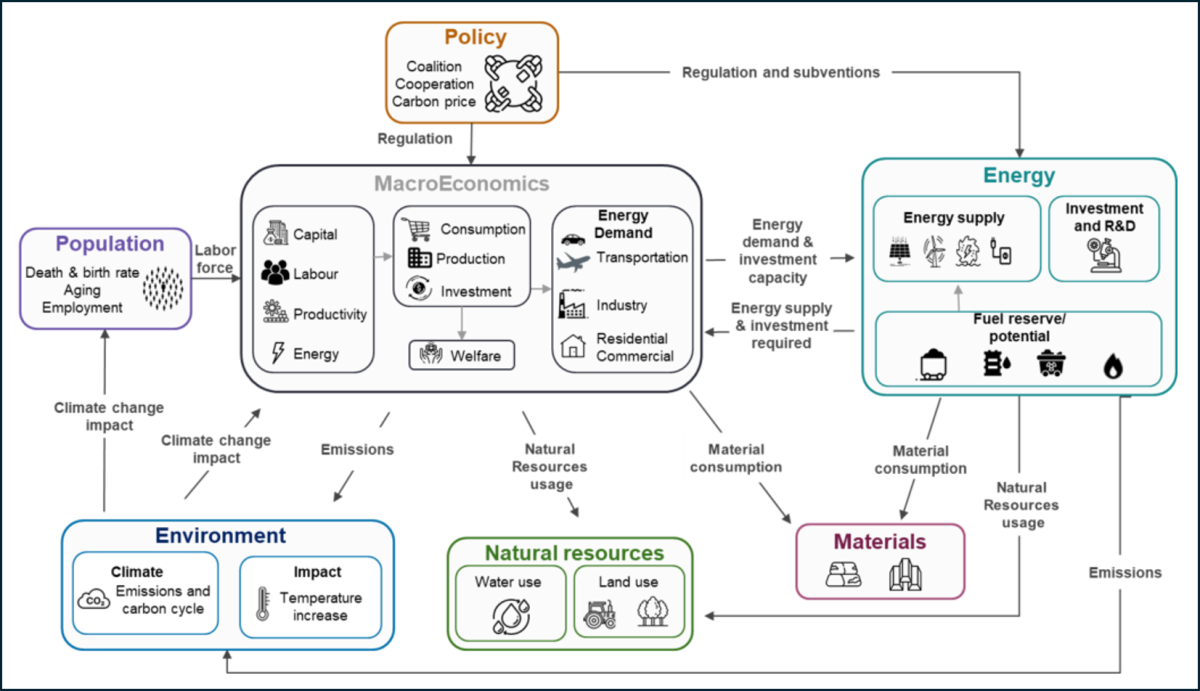
Key coupling assumptions in WITNESS

“Labour without energy is a corpse; capital without energy is a sculpture.” Steve Keen▪

Gross Domestic Product depends on capital, labour and net energy output (see here)

  • usable capital : capital needs to be fed with energy, for it to be able to produce output
  • maximum usable energy of capital : not able to absorb more energy that it is built for
  • productivity factor of capital : representing loss of productivity if minimum number of labour are not available

Need to have a population model to properly create world scenarios (as in World3 model – see here)

  • labour : GDP depends on evolving population age distribution
  • population : impacted by climate change damage (extreme weather conditions, sea level rise, etc…)
  • amount of food available : evolves with climate change impact on productivity of agriculture and land usage

Access to net energy production to properly feed production function (see here)

  • production technologies : needed to model resources impact and interdependencies in global energy production mix
  • production interdependencies : to solve net energy production computation
  • production investments in energy sector : linked to overall GDP as depending on economy evolutions

Earth is a finite system with many resources boundaries reflected in the framework (e.g. copper, land use…)

  • resources consumption: tracked (e.g. energy, economy, agriculture…) & pitched against reserve estimations
  • capital : all assets, for instance factories, buildings, machines and so on
  • labour : employed population, changes depending on age distribution and population evolution.
  • net energy output: usable energy, removing from raw production, energy used to produce energy itself

SoSTrades / WITNESS usages

Integrated Assessment Models (IAMs) such as WITNESS play a pivotal role in addressing the intertwined challenges of climate change and energy. Developed by experts and researchers, IAMs serve as powerful tools for exploring sustainable pathways and generating transition scenarios. These transition scenarios play a pivotal role in our understanding of global transitions. They serve as bridges connecting research, policy, and business, guiding collective efforts toward a sustainable and resilient future. These scenarios consider a wide range of factors, including economic growth, temperature rise, CO₂ concentration, and climate damages.

Initially, public institutions and financial bodies utilize these scenarios. They leverage global quantities derived from these IAMs outputs, such as GDP, temperature increase, CO₂ concentration, and climate damages. Using these data, they create reference scenarios, such as the IEA “APS” (Announced Pledges Scenario) or “STEPS” (Stated Environmental Policies Scenario), as well as NGFS bank stress testing scenarios. Analyzing these reference scenarios allows for a more accurate estimation of global risks. The findings serve as crucial warnings for decision-makers, enabling them to shape or adjust policies, including legal taxes and constraints.

Private actors, building upon the groundwork laid by IAM results and public institutions’ announced strategies, can then explore transition paths focused on their varying interests. Some focus on Generic Consequences Analysis and broad impacts, such as physical risks or financed emissions estimation. Others seek specific insights relevant to their operations, which may not always be readily available in traditional IAMs. These insights could include material availability, energy availability, and pricing for specific mixes.

Search